

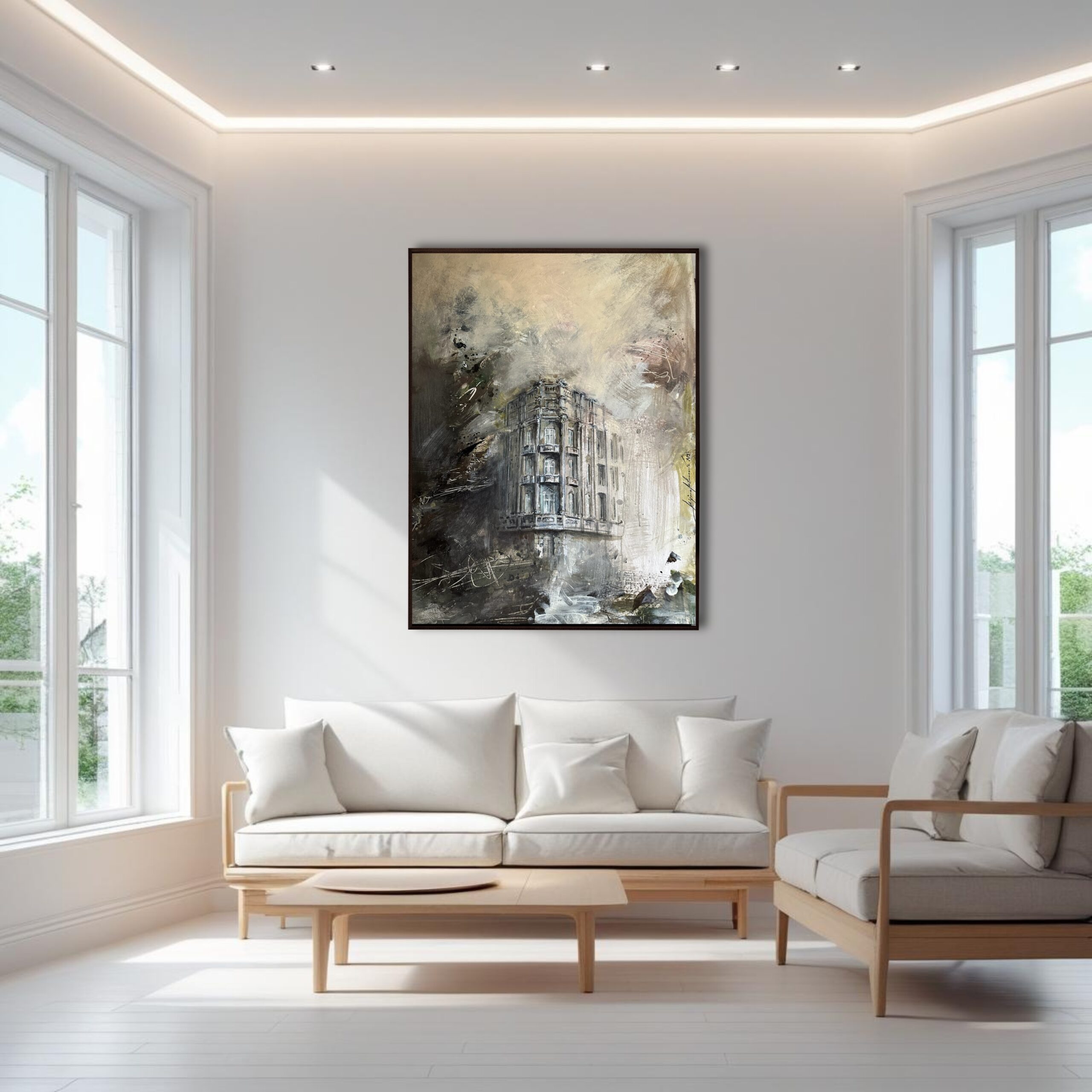
Academic painter Mirjana Mira Milovanović continuously develops her artistic expression, persistently exploring the boundaries of form, composition, and medium. Her work is characterized by openness to different techniques and styles, where each approach becomes a tool for articulating inner visions and emotions. Whether through precisely constructed drawings, expressive portraits, or vibrant abstract compositions on canvas, her pieces carry a strong individual imprint and a clear artistic intention.
At the center of her visual expression lies abstract painting, distinguished by a unique sensibility for architectural elements. Mira does not perceive architecture merely as a motif but as a conceptual framework that she integrates into her artistic language. Structure, form, and space in her works function as living entities—dynamic, rhythmic, and often contemplative. Through multilayered surfaces, intricate linear flows, and thoughtful color relationships, she creates visual fields that encourage contemplation and introspection.
Her canvases—most often medium and large format—leave a powerful impression through their energy, depth, and emotional intensity. Yet, Mira approaches her creative practice with empathy and dialogue—both with the space and with the people for whom she creates. In commissioned works, she approaches each project with exceptional care, attentively listening to the client’s needs and the interior context in which the piece will exist. Thus, her paintings are not merely decorative elements; they become an integral part of the space, introducing a layered artistic dimension and an authentic atmosphere.
She devotes particular attention to color, which in her hands acquires profound symbolic and psychological power. For Mira, color is more than a means of expression—it is the carrier of emotion, the initiator of narrative, and a bridge between the inner and outer world. Thanks to this relationship with the medium, her works radiate vitality and pulsating energy.
In every segment of her artistic practice, one can recognize her dedication to the process, her exploratory spirit, and a constant need to transcend the boundaries of the known. Mira intertwines seemingly contradictory notions—intuition and structure, freedom and order, emotion and rationality—creating compositions that speak the universal language of art while preserving personal authenticity and distinctiveness.
The works of Mirjana Mira Milovanović not only reflect a contemporary artistic sensibility but also possess a timeless quality, making them relevant in gallery, private, and public spaces alike. Her painting invites quiet reflection, dialogue, and emotional experience—and remains memorable precisely because of its ability to address each viewer on both a deeply personal and universal level.

Art is one of the deepest and oldest expressions of human consciousness.
Throughout the centuries, painting has served as a medium for communication, interpretation of the world, and spiritual expression. Even in the cave drawings of Paleolithic humans, we recognize the urge to transmit experience through shape and color. In ancient civilizations — Egypt, Mesopotamia, Greece — painting was intertwined with religion, myth, and power. During the Middle Ages, art served Christian symbolism, and paintings were considered windows into the divine.
The Renaissance marked a turning point — man became the center of the universe, and the artist emerged not just as a craftsman, but as a creator. Leonardo, Michelangelo, and Raphael shaped the idea of art as an exploration of light, proportion, and spiritual beauty. In the Baroque era, painting became a drama of light and motion. Later movements like Romanticism, Realism, and Impressionism changed perception — art no longer simply imitated reality, but interpreted it through the inner eye of the artist.
In the 20th century, painting underwent a revolution — Cubism, abstraction, Expressionism, and conceptual art dissolved the boundaries between form and content. Painting ceased to be mere representation; it became an idea, a statement, an emotion — often a political commentary. Today, painting engages in dialogue with digital media, yet retains its authenticity through the immediacy of gestural expression and the tactile nature of materials.
Art has the power to connect eras, cultures, and individuals.
Through the image, humans leave behind a trace of their time, their perspective, their sensitivity. Painting is both document and vision — history and contemporaneity in a single brushstroke. Its significance lies not only in aesthetic value but in its capacity to shape our understanding of the world and of ourselves.
When Art Becomes Space
The Significance of Art in Space
A canvas painting is not merely an aesthetic addition or a decorative element on the wall – it is a visual impulse that brings space to life, infusing it with spirit, emotion, and presence. In the moment when colors unite under the artist’s hand, the canvas becomes a carrier of meaning, and the wall ceases to be just an architectural surface – it becomes a stage of emotion, silent narration, and personal symbolism.
Art transforms space not invasively, but subtly and powerfully. It brings rhythm to the stillness of walls, gives a voice to silence, and makes the light fall differently, letting shadows move with intention. The painting becomes an energetic point around which the emotional topography of the interior is formed – it does not demand attention, yet it is always present, like a heartbeat defining the life of the room.
Without art, space remains mute – functional but without identity, like a sentence without a period, like a room without a soul. A painting brings warmth, depth, and a sense of continuity between what is outside and what is within. It connects the material and the immaterial, the physical structure and the emotional experience.
Every true work of art contains the breath of a moment and the absence of time – it is both immediate and eternal, a vessel of a thought, an impulse, a silence that becomes color. A painting does not only show what is seen – it reveals what is felt, sensed, remembered. It is an encounter: between the artist who creates, the canvas that receives, and the viewer who experiences. In that union, something emerges that surpasses all three – the living presence of art within space.
When a painting is thoughtfully selected and placed in harmony with its environment, it does not occupy space – it shapes it. The entire ambiance begins to breathe through it. Walls, light, objects, and silence align with its rhythm, color, and form. The space becomes poetry – unspoken yet profoundly present; visual yet deeply emotional.
For this reason, the role of art in space transcends decoration. A painting becomes a point of identity, a record of the inner world, a mirror of emotion. It holds the power to connect space with the person within it, transforming it into a personal, sensory environment that inspires, calms, or activates. Art does more than change the space – it changes the way we experience it.